CISSP PRACTICE QUESTIONS – 20191218

Effective CISSP Questions

Your company decides to start the business of selling toys online and shipping globally. A software development team in-house has gone through analysis, design, development, and testing. Shortly after the E-Commerce system goes into operations, it suffers SQL injection attacks and data breach. As a security professional, which of the following is the best strategy to conduct threat modeling to mitigate risks?
A. In the initial design stage
B. In the testing stage
C. As late as in the operations stage
D. All of the above

Continue reading

Service Organization Control Resources

11v2-understanding-the1

Audit and Attest

An obvious difference for the service auditor is the change from auditto attest. AICPA states that audit services are reserved for financial audit, and thus, what the service auditor does is attest. As such, the new standard was issued as an SSAE, applied under AT 101. Attest services are very definitive; management identifies specific procedures and the auditor then performs exactly those procedures (agreed-upon procedures [AUPs]). This approach fits the evaluation of controls for an SO (Service Organization).

A new requirement, among others, is that management must provide a written assertionabout the fairness of the presentation of the description of the system and the suitability of the design (type I) and effectiveness (type II) of the controls. The written assertion is part of the final report by the service auditor.

Source: Understanding the New SOC Reports

SSAE No. 18

  • Service organization. An organization or segment of an organization that provides services to user entities, which are likely to be relevant to those user entities’ internal control over financial reporting.
  • User entity. An entity that uses a service organization for which controls at the service organization are likely to be relevant to that entity’s internal control over financial reporting.
  • Service organization’s assertion. A written assertion about the matters referred to in part (b) of the definition of management’s description of a service organization’s system and a service auditor’s report on that description and on the suitability of the design and operating effectiveness of controls, for a type 2 report, and, for a type 1 report, the matters referred to in part (b) of the definition of management’s description of a service organization’s system and a service auditor’s report on that description and on the suitability of the design of controls.
  • Type 1 report. See management’s description of a service organization’s system and a service auditor’s report on that description and on the suitability of the design of controls.
  • Type 2 report. See management’s description of a service organization’s system and a service auditor’s report on that description and on the suitability of the design and operating effectiveness of controls.
  • Test of controls. A procedure designed to evaluate the operating effectiveness of controls in achieving the control objectives stated in management’s description of the service organization’s system.
  • Service organization’s system. The policies and procedures designed, implemented, and documented by management of the service organization to provide user entities with the services covered by the service auditor’s report. Management’s description of the service organization’s system identifies:
    • the services covered,
    • the period to which the description relates (or in the case of a type 1 report, the date to which the description relates),
    • the control objectives specified by management or an outside party,
    • the party specifying the control objectives (if not specified by management), and
    • the related controls. (Ref: par..A8)
  • Controls at a service organization. The policies and procedures at a service organization likely to be relevant to user entities’ internal control over financial reporting. These policies and procedures are designed, implemented, and documented by the service organization to provide reasonable assurance about the achievement of the control objectives relevant to the services covered by the service auditor’s report. (Ref: par. .A7)
  • Control objectives. The aim or purpose of specified controls at the service organization. Control objectives address the risks that controls are intended to mitigate.

CISSP PRACTICE QUESTIONS – 20191217

Effective CISSP Questions

Alice encrypted a document using AES with an encryption key that is a combination of her birthday and phone number. She has sent the document to bob through e-mail and is considering how to deliver the key securely. Which of the following is the least feasible?”
A. Print the key out and send it through a courier
B. Text the key using WhatsApp
C. Mail him a one-time password token to generate the key
D. Send the key encrypted by Bob’s public key through email

Continue reading

CISSP PRACTICE QUESTIONS – 20191216

Effective CISSP Questions

Which of the following statements best describes “confidentiality?”
A. How the system protects data from unauthorized access
B. Access to the system by authorized personnel
C. How the system prevents the disclosure of information
D. Process of determining the identity of a user

PS. These answer options are excerpts from the ISC2 online course, Assessing Application Security.

Continue reading

The Definition of Threat

Wentz’s Risk Model

Based on ISO 31000 (risk is the “effect of uncertainty on objectives”), the NIST Generic Risk Model, and the risk metalanguage proposed by Dr. David Hillson, I define a threat as follows:

A threat is a risk with a negative effect as a threat source may initiate a threat event to exploit vulnerabilities and cause an adverse impact on the security objectives if it happens.

CISSP PRACTICE QUESTIONS – 20191214

Effective CISSP Questions

Your company decides to start the business of selling toys online and shipping globally. A software development team in-house is in charge of developing a web-based E-Commerce system that supports the new business. You are assigned as the project manager of the software development project. Which of the following artifact is the source of authority for your assignment?
A. Master project management plan
B. Project charter
C. Software development policy
D. Business case

Continue reading

SPML, SAML, XACML, and SSO

SPML, SAML, and XACML

  • SPML helps streamline the provisioning process.
  • SAML facilitates federated identity and single sign-on. (The sequence diagram is highly simplified. The HTTP methods and redirections are not depicted. Pls refer to SAML specification for details.)
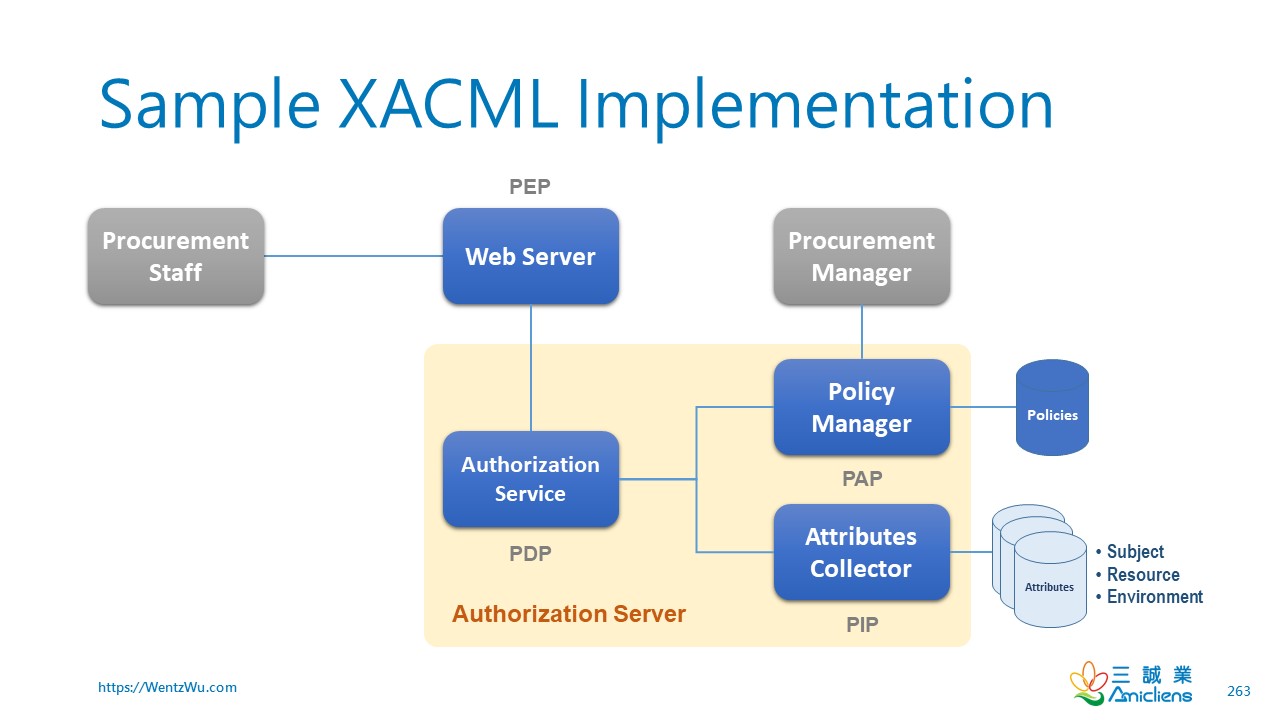
  • XACML enables attribute-based access control.

These three XML-based protocols are proposed by OASIS. They are a good fit to integrate solutions across vendors or build the extranet.

SPML
SAML
Single Sign-On
Sample XACML Implementation